
You finally found a gluten-free bread you actually like. You made a sandwich, took a bite, and then — the cramping, bloating, or nausea hit. Now you’re wondering if the bread really is gluten-free, or if something else is going on.
You’re not imagining it, and you’re definitely not alone. Many people experience stomach pain after eating gluten-free bread, and the culprit usually isn’t gluten — it’s the other ingredients. Gluten-free breads rely on a completely different set of starches, gums, fibers, and additives that can be surprisingly hard on sensitive digestive systems.
As a nurse and someone who’s been managing a gluten-free household for years, I’ve troubleshot this exact problem more times than I can count. When my son Alex first went GF, we went through four brands of bread before we found one that didn’t leave him curled up on the couch. It was frustrating — but once we understood what was actually causing the problem, fixing it was straightforward.
This article breaks down the most common reasons why stomach hurt after gluten free bread, how to identify your specific trigger, and what to do about it — so you can actually enjoy your sandwich in peace.
Key Takeaways
- Gluten-free bread contains high-FODMAP ingredients like inulin, chicory root fiber, and sugar alcohols that commonly cause bloating, gas, and stomach pain — even in people without celiac disease.
- Xanthan gum and guar gum, used as gluten replacers in nearly all GF breads, can trigger digestive distress in sensitive individuals when consumed regularly.
- Cross-contamination is a real possibility — not all “gluten-free” labeled products meet the same safety standards, and shared facility manufacturing can introduce trace gluten.
- Identifying your trigger requires a systematic approach — start by eliminating one suspect ingredient at a time rather than giving up on GF bread entirely.
- Certified gluten-free breads with simpler ingredient lists tend to be easier on digestion than those packed with fiber additives and stabilizers.
The Most Common Culprits Behind GF Bread Stomach Pain
When patients tell me their stomach hurts after eating gluten-free bread, my first question is always: “Can I see the ingredient list?” The answer is almost always hiding right there.
Gluten-free bread is an engineering challenge. Without gluten’s stretchy protein network, manufacturers have to compensate with a cocktail of binders, fibers, and stabilizers. Many of these ingredients are perfectly safe for most people — but if you have a sensitive gut (which, if you’re eating GF bread, you very likely do), they can cause real problems.
Sugar Alcohols and High-FODMAP Sweeteners
Some gluten-free breads contain sugar alcohols like sorbitol, mannitol, or xylitol to improve flavor and moisture. These are poorly absorbed in the small intestine and get fermented by gut bacteria in the colon, producing gas, bloating, and sometimes diarrhea.
Even if your bread doesn’t list sugar alcohols directly, check for inulin and chicory root fiber. These are popular fiber boosters in GF products, and they’re high-FODMAP ingredients that cause significant GI distress in many people. Research from Mayo Clinic notes that inulin-type fructans can cause bloating and abdominal pain, particularly in people with irritable bowel syndrome (IBS).
Xanthan Gum and Guar Gum
These two gums are the backbone of almost every gluten-free baked good. They mimic gluten’s binding properties and give GF bread its structure. But they’re also soluble fibers that draw water into the intestines and can cause bloating, gas, and cramping — especially in larger amounts.
One slice of bread probably won’t do it. But if you’re having GF bread for breakfast, a GF wrap at lunch, and GF crackers for a snack, that’s a lot of gum accumulating throughout the day. When Alex was having daily stomach aches, I realized he was getting xanthan gum in virtually every meal. Cutting back to one gum-containing product per meal made a noticeable difference.
High Fiber Content and Resistant Starches
Many GF bread brands add extra fiber to compensate for the naturally lower fiber content of refined GF flours. Ingredients like psyllium husk, flaxseed meal, pea fiber, and resistant tapioca starch can dramatically increase the fiber content of a single serving.
If you went from eating regular white bread (about 1g fiber per slice) to a GF bread with 4-6g of fiber per slice, your gut didn’t get the memo. A sudden fiber increase is one of the most common causes of bloating, gas, and stomach cramping — and it has absolutely nothing to do with gluten.
Specific Flour Sensitivities
Gluten-free bread typically blends multiple flours — rice flour, tapioca starch, potato starch, sorghum flour, millet flour, and sometimes bean flours (chickpea, fava, or navy bean). Any one of these can be a trigger for individual people.
Bean-based flours are a particularly common offender. They’re high in oligosaccharides (part of the FODMAP family), which ferment in the gut and cause gas and bloating. If your GF bread lists garbanzo bean flour, fava bean flour, or chickpea flour near the top of the ingredient list, that could be your answer.
Could It Actually Be Cross-Contamination?
Before we dive deeper into additives, let’s address the elephant in the room. Sometimes the reason your stomach hurts after eating gluten-free bread is that the bread contains trace amounts of gluten.
The U.S. Food and Drug Administration (FDA) requires that products labeled “gluten-free” contain less than 20 parts per million (ppm) of gluten. That’s the threshold considered safe for most people with celiac disease. However, there are important nuances.
- Shared facility manufacturing: Some GF breads are produced in facilities that also process wheat. Even with cleaning protocols, trace gluten can sneak in.
- “Gluten-free” vs. certified gluten-free: A product can self-label as “gluten-free” without third-party verification. Certifications from organizations like the Gluten-Free Certification Organization (GFCO) require testing to 10 ppm or less — a stricter standard.
- Cumulative exposure: If you’re eating multiple products that each hover near the 20 ppm threshold, your total daily gluten intake could add up enough to cause symptoms.
How to Identify Your Specific Trigger
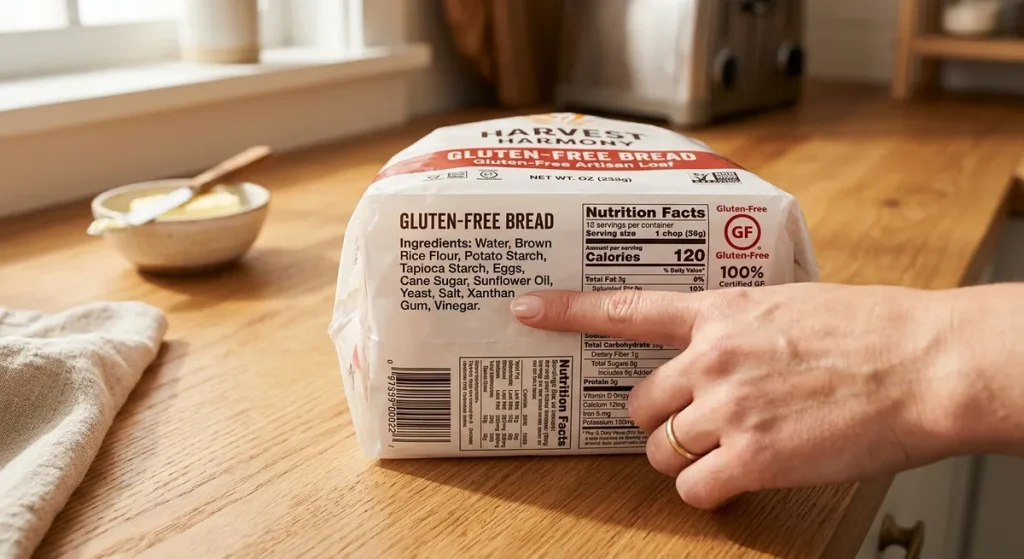
I know it’s tempting to just throw your hands up and swear off GF bread forever. But with a little detective work, most people can pinpoint the exact ingredient causing problems — and find a bread that works for them.
GF Bread Troubleshooting Steps
- Write down the exact brand and variety of bread that caused symptoms
- Note the full ingredient list (take a photo of the package)
- Record your symptoms and when they started after eating
- Check if the product is certified GF (GFCO, NSF, or Beyond Celiac seal) or just self-labeled
- Compare ingredients with any GF bread you’ve tolerated well
- Try eliminating one suspect ingredient category at a time
- Keep a simple food-symptom diary for at least 2 weeks
The Elimination Approach
Start with the most common offenders and work your way down. Try a bread without bean flours first. If that doesn’t help, look for one without inulin or chicory root fiber. Then try a brand with minimal or no xanthan gum (some breads use psyllium husk as the sole binder instead).
This process takes patience — usually 2-3 weeks of testing per change — but it’s far more effective than randomly switching brands and hoping for the best.
When to Consider a Low-FODMAP Trial
If you’re reacting to multiple GF products — not just bread — a low-FODMAP diet supervised by a registered dietitian may help. The low-FODMAP approach temporarily removes fermentable carbohydrates that feed gut bacteria, then systematically reintroduces them to identify your specific triggers.
This is especially worth exploring if you have both celiac disease and ongoing IBS-type symptoms. Many people find that going gluten-free solves part of their problem, but FODMAP sensitivity is the other piece of the puzzle.
GF Bread Brands That Are Easier on Digestion
Based on my family’s experience and what I hear consistently from the GF community, here are breads that tend to be better tolerated — along with what makes them different.
GFCO-certified, no bean flours, no inulin, no artificial additives. Uses a simple rice-and-tapioca flour base with whole grain sorghum. This is the bread Alex can eat without any issues.
Extremely simple ingredient list with no bean flours or chicory root fiber. GFCO-certified to 10 ppm. Good option if you want a mild, easy-to-digest white bread. Around $5-6 per loaf.
Free from common allergens including soy and nuts. No bean flours. Uses pea starch (different from pea fiber — usually better tolerated). GFCO-certified. Around $6-7 per loaf.
Making your own gives you complete ingredient control. Start with a simple recipe using rice flour, tapioca starch, and psyllium husk — skip the xanthan gum entirely.
Brands More Likely to Cause Digestive Issues
I’m not saying these are bad products — they’re not. But if you have a sensitive stomach, these ingredient profiles tend to be more problematic:
- Breads heavy in bean flours (garbanzo, fava) — common in some Udi’s and generic store-brand varieties. The oligosaccharide content is significantly higher.
- Breads with added inulin or chicory root fiber — often marketed as “high fiber” GF bread. Great for some people, a nightmare for others.
Common Mistakes When Troubleshooting GF Bread Problems
- Assuming it must be gluten. The bread might be perfectly gluten-free — and the problem might be xanthan gum, bean flour, or a FODMAP ingredient. Don’t throw out a safe product until you’ve investigated.
- Switching brands randomly. If you jump from brand to brand without comparing ingredient lists, you might keep landing on the same trigger ingredient in different packaging.
- Eating too much GF bread at once. GF bread is denser and often higher in fiber and gums than conventional bread. Two thick slices of a high-fiber GF bread is a lot more gut work than you might think.
- Ignoring the “adjustment period.” If you’re newly gluten-free, your gut is still healing. Research suggests it can take months for the intestinal lining to recover from celiac-related damage, and during that time, your gut may be more reactive to all kinds of foods.
- Not checking for certification. A “gluten-free” label on the front doesn’t always mean the product has been independently tested. Look for the GFCO circular seal or NSF Gluten-Free certification mark for extra assurance.
Frequently Asked Questions
Absolutely. Celiac disease means you react to gluten, but it doesn’t make you immune to other food sensitivities. Many people with celiac disease also have trouble digesting FODMAPs, certain gums, or specific starches found in GF bread. If your celiac antibodies are normal but you’re still having symptoms, the bread’s non-gluten ingredients are the most likely culprit.
It can. Xanthan gum is a soluble fiber produced by bacterial fermentation. In small amounts, most people tolerate it fine. But when you’re consuming it in bread, crackers, baked goods, and sauces throughout the day, the cumulative amount can cause bloating, gas, and loose stools in sensitive individuals.
The only definitive way is testing. At-home gluten detection kits like Nima Sensor can test individual food portions for gluten above 20 ppm. You can also check if your bread carries a third-party certification like GFCO (tests to 10 ppm). If you suspect contamination is causing symptoms, switching to a GFCO-certified brand is a good first step.
Homemade GF bread typically has a much shorter, simpler ingredient list — and you control exactly what goes in. Store-bought versions often contain preservatives, emulsifiers (like DATEM or mono- and diglycerides), added fiber like inulin, and higher amounts of gums. Any of these can be the ingredient your gut is reacting to.
Not necessarily — but you should investigate why. Try a different brand with a simpler ingredient list, reduce your portion size, or try homemade bread where you control every ingredient. If problems persist across multiple brands and homemade versions, consult a gastroenterologist or registered dietitian who specializes in celiac disease to rule out other digestive conditions.
Become an Ingredient Detective, Not a GF Bread Quitter
If your stomach hurts after eating gluten-free bread, the most likely culprits are high-FODMAP ingredients like inulin and chicory root fiber, bean-based flours, cumulative xanthan gum intake, or a sudden increase in fiber. True cross-contamination with gluten is possible but less common — especially if you’re choosing certified brands.
The fix isn’t to give up on GF bread. It’s to become an ingredient detective. Compare labels, test one change at a time, and consider keeping a food diary for a couple of weeks. Most people can find a bread — or make one — that their gut tolerates just fine. And if you’re newly gluten-free, give your body grace. Your gut is healing, and sensitivity to multiple ingredients is normal during that transition. It does get better.
If you’re still struggling with digestive issues on a gluten-free diet, download our free GF Nutrition Cheat Sheet — it covers common digestive triggers, what to watch for on labels, and when to talk to your doctor. Because figuring this out shouldn’t be something you have to do alone. 💚
