Finding the best gluten-free grocery stores can feel like navigating a maze — especially when you’re newly diagnosed and every shopping trip takes twice as long. You’re squinting at labels, Googling ingredients in the middle of aisle seven, and wondering if that “wheat-free” claim actually means anything.
I’ve been there. When our family first went gluten-free, I spent more time in grocery stores than I did at home (or at least it felt that way). After years of shopping at nearly every major chain across the country — and hearing from thousands of GF families in our community — I’ve developed a pretty clear picture of which stores actually deliver for the gluten-free community.
The best gluten-free grocery stores in 2026 are Sprouts Farmers Market, Whole Foods Market, Trader Joe’s, and Aldi, based on selection, labeling clarity, dedicated GF store brands, and affordability. But the right store for you depends on your budget, location, and how strict your GF needs are.
In this ranking, I’ll break down the top grocery chains for gluten-free shopping, what makes each one stand out, and the common mistakes that can derail even experienced GF shoppers at the store.
Key Takeaways
- Sprouts Farmers Market takes the #1 spot in 2026 for its massive dedicated GF sections, clear labeling, and competitive pricing on specialty items.
- You don’t need a specialty store to eat safely gluten-free — even mainstream chains like Kroger, Walmart, and Aldi have significantly expanded their celiac-friendly options.
- Store brand GF products can save you 25-40% compared to national brands, and stores like Aldi, Trader Joe’s, and Kroger offer excellent private-label GF lines.
- Dedicated GF sections aren’t always safer — understanding labeling, certifications, and cross-contamination policies matters more than shelf placement.
- Online ordering and curbside pickup have become game-changers for GF shoppers who want to filter by dietary need before they ever set foot in a store.
The 2026 Ranking: Best Gluten-Free Grocery Stores
I evaluated these stores based on five criteria that matter most to GF families: selection and variety, labeling clarity, dedicated GF store brands, pricing, and the overall shopping experience (including staff knowledge and online filtering tools). Here’s where they landed.
#1: Sprouts Farmers Market
Sprouts has quietly become the best overall grocery store for gluten-free shoppers in 2026. Their dedicated gluten-free aisle is typically one of the largest you’ll find at any chain, and they carry deep selections from brands like Siete Family Foods, Simple Mills, Jovial, and Canyon Bakehouse.
What sets Sprouts apart is pricing. They consistently undercut Whole Foods on specialty GF items by 10-20%, and their bulk bins section — while requiring cross-contamination awareness — offers GF-labeled grains, flours, and snacks at significant savings. Their weekly sales often feature GF products, which is rare at other chains.
Sprouts also earns points for their produce-forward store layout. When you shop the perimeter (fresh fruits, vegetables, meats, and seafood), you’re naturally shopping gluten-free without even trying. Their staff tends to be knowledgeable about dietary restrictions, and their app allows you to filter products by “gluten-free” before you shop.
#2: Whole Foods Market
Whole Foods Market remains a powerhouse for gluten-free shopping, and their quality standards are still the gold standard in the industry. Every product on their shelves meets strict ingredient guidelines — you won’t find artificial colors, flavors, or hydrogenated fats here, which simplifies label reading considerably.
Their 365 by Whole Foods Market store brand includes a robust lineup of GF products, from pasta and crackers to frozen pizzas and baking mixes. Many carry the Gluten-Free Certification Organization (GFCO) certification, which means they’ve been tested to contain fewer than 10 parts per million (ppm) of gluten — stricter than the FDA’s 20 ppm threshold.
The biggest drawback? Price. Whole Foods is consistently the most expensive option on this list, even with Amazon Prime member discounts. For families on a budget, the “Whole Paycheck” reputation still holds true on many GF staples. That said, their prepared foods section and bakery often have clearly labeled GF options that make busy weeknights easier.
#3: Trader Joe’s
Trader Joe’s has earned a devoted following in the gluten-free community, and for good reason. They publish and regularly update a comprehensive gluten-free product list organized by category, which you can pick up in-store or find on their website. This alone saves enormous time.
Their private-label GF products are genuinely good. The Trader Joe’s Gluten Free Crispy Crunchy Chocolate Chip Cookies, GF Mac and Cheese, and Cauliflower Gnocchi have become staples in GF households nationwide — including mine. My boys actually prefer the TJ’s GF chocolate chip cookies to conventional ones, which is saying something.
The challenge with Trader Joe’s is consistency. Because they rotate products frequently, your favorite GF item might disappear without warning. Their stores are also smaller, which means the overall GF selection is more limited than what you’d find at Sprouts or Whole Foods. But the price-to-quality ratio is unbeatable.
#4: Aldi
If you’re looking for the best gluten-free grocery store on a budget, Aldi deserves serious consideration. Their liveGfree store brand is one of the most impressive GF private-label lines in grocery retail, covering everything from bread and pizza to cookies, brownie mix, and frozen meals.
The liveGfree line is not only affordable — often 30-40% less than comparable national brands — but many products are also GFCO certified. For a family spending $200+ per week on gluten-free groceries, switching to Aldi for staples can save hundreds of dollars per month.
Aldi’s limitations are real, though. Their stores are small, and the overall variety can’t compete with a Sprouts or Whole Foods. They carry fewer specialty brands, so if you’re looking for something specific like Siete grain-free tortillas or Hu Kitchen chocolate, you’ll need to shop elsewhere. But for the GF basics? Aldi is hard to beat.
#5: Kroger (and Kroger Family Stores)
Kroger — along with its family of stores including Ralphs, Fred Meyer, Harris Teeter, King Soopers, and Fry’s — has made significant strides in gluten-free selection. Their Simple Truth Free From line includes a growing number of GF products, and their online platform makes it easy to search and filter by “gluten-free.”
What makes Kroger stand out among mainstream grocers is their store layout integration. Rather than relegating all GF items to a single “specialty” aisle, they’ve increasingly placed GF alternatives alongside their conventional counterparts. You’ll find GF pasta next to regular pasta, GF bread in the bread aisle, and GF crackers with the other crackers. This normalization matters — it makes GF shopping feel less isolating.
Kroger also runs one of the better digital coupon programs in the industry, and GF products frequently appear in their personalized offers. If you shop Kroger consistently, their loyalty program will start surfacing GF deals tailored to your purchase history.
#6: Walmart
I know — Walmart isn’t the first store that comes to mind when you think “best gluten-free grocery stores.” But hear me out. For many families, especially those in rural areas or food deserts, Walmart may be the only option. And honestly? They’ve gotten significantly better.
Walmart’s Great Value brand now includes several GF-labeled products, and their shelves carry mainstream GF brands like Glutino, Schar, Canyon Bakehouse, and Bob’s Red Mill. Their online grocery pickup lets you search “gluten-free” and filter results, which eliminates a lot of the in-store stress.
The downsides are notable: GF products are often scattered throughout the store with no dedicated section, staff knowledge about gluten-free diets tends to be limited, and the overall specialty selection is thinner than competitors. But for accessibility and everyday pricing, Walmart fills an important gap.
#7: Costco
Costco earns a spot on this list for one reason: bulk GF buying power. If you’ve found GF products you love, Costco’s warehouse pricing can save you significantly. Their Kirkland Signature brand includes several GF items, and they carry bulk packs of popular brands like Siete, Simple Mills, and Made Good.
Costco’s GF frozen section deserves special mention. They carry large bags of Caulipower pizza crusts, Against the Grain frozen pizzas, and GF chicken nuggets that make weeknight dinners much easier. Their snack section also regularly features GF options in larger quantities than you’d find at traditional grocers.
The catch is unpredictability. Like Trader Joe’s, Costco rotates products, and a GF item you bought last month might not be there next time. There’s also no dedicated GF section — you have to hunt. But if you’re feeding a GF family and want to stock up, the savings are real.
| Store | GF Selection | GF Store Brand | Price Level | Overall GF Rating |
|---|---|---|---|---|
| Sprouts Farmers Market | Excellent | Sprouts Brand | $$ | ⭐⭐⭐⭐⭐ |
| Whole Foods Market | Excellent | 365 by Whole Foods | $$$ | ⭐⭐⭐⭐⭐ |
| Trader Joe’s | Good | Trader Joe’s | $$ | ⭐⭐⭐⭐ |
| Aldi | Good | liveGfree | $ | ⭐⭐⭐⭐ |
| Kroger | Good | Simple Truth Free From | $$ | ⭐⭐⭐⭐ |
| Walmart | Moderate | Great Value (limited) | $ | ⭐⭐⭐ |
| Costco | Moderate | Kirkland Signature | $ | ⭐⭐⭐ |
What Makes a Grocery Store Great for Gluten-Free Shopping?
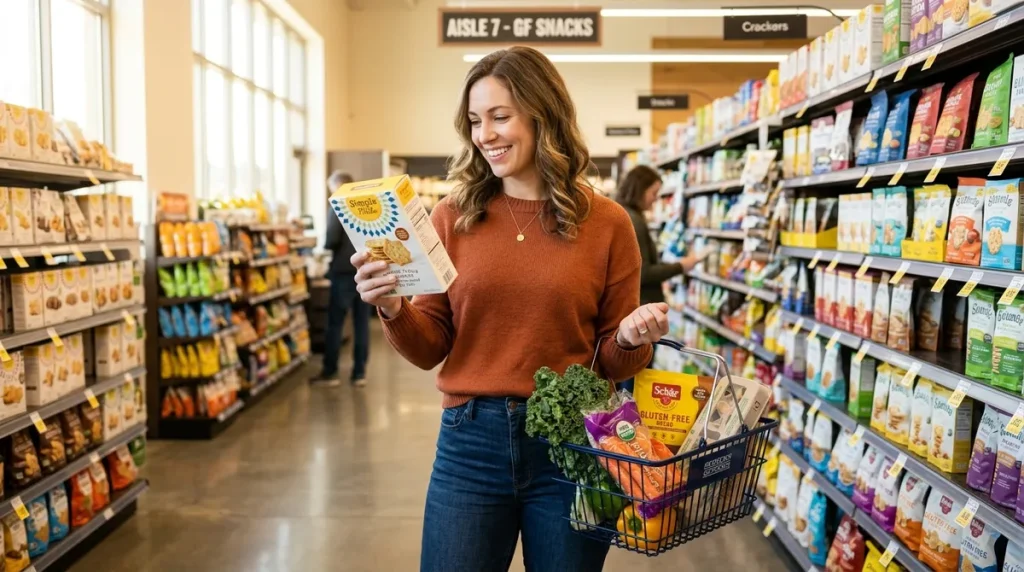
Rankings are helpful, but understanding why these stores earn their spots will help you evaluate any grocery store — including regional chains I haven’t covered. Here are the factors that matter most.
Dedicated GF Sections vs. Integrated Placement
There’s an ongoing debate in the GF community: is it better to have a dedicated gluten-free aisle, or should GF products be placed alongside their conventional counterparts? The answer is both.
Dedicated sections are a lifesaver when you’re newly diagnosed. You can walk to one spot and find everything from GF bread to pasta to baking mixes without wandering the entire store. Sprouts and Whole Foods excel here.
But integrated placement — where GF pasta sits next to regular pasta — is actually better for experienced GF shoppers. It lets you compare prices directly and discover new products you might miss if you only shop the “specialty” aisle. Kroger has leaned into this approach, and I think it’s the future.
Labeling and Certification Standards
A store is only as good as the clarity of its labeling. The FDA requires that any product labeled “gluten-free” contain fewer than 20 ppm of gluten. But third-party certifications go further.
Look for the GFCO (Gluten-Free Certification Organization) logo, which tests to fewer than 10 ppm, or the NSF International gluten-free certification. Stores like Whole Foods and Aldi tend to carry more products with these certifications, which is a significant advantage for shoppers with celiac disease.
Store Brand GF Quality and Value
The rise of quality GF store brands has been one of the biggest wins for our community. Here’s a quick breakdown of the standout private-label GF lines:
Covers bread, pizza, pasta, cookies, brownie mix, and frozen meals. Many items GFCO certified. Consistently 30-40% cheaper than national brands.
Premium quality GF crackers, pasta, baking mixes, and frozen items. Many carry GFCO certification. Higher price point but excellent quality.
Best known for GF cookies, mac and cheese, cauliflower gnocchi, and snacks. Published GF list updated regularly. Great value.
Growing lineup of GF pasta, snacks, and baking items. Widely available across Kroger family stores. Competitively priced.
Online Shopping and Curbside Pickup for GF Families
Honestly, online grocery shopping has been a game-changer for our gluten-free family. Being able to search “gluten-free” and filter results before you ever enter the store eliminates so much stress and saves time.
Kroger, Walmart, and Whole Foods (through Amazon) all offer robust GF filtering in their apps and websites. Sprouts has improved their online ordering significantly in 2025-2026, though their filtering isn’t quite as refined. Trader Joe’s still doesn’t offer online grocery ordering at most locations, which is their biggest weakness for busy GF families.
If you have celiac disease or a severe gluten sensitivity, curbside pickup offers another advantage: someone else handles the products in the gluten-filled store, reducing the mental load of navigating aisles full of items you can’t eat.
How to Maximize Your GF Grocery Budget
Let’s talk about the elephant in the room: gluten-free food is expensive. Research from the Celiac Disease Foundation and consumer studies consistently show that GF products cost 100-200% more than their conventional counterparts. Here’s how to fight back.
One strategy that’s worked well for our family: I do a monthly “big shop” at Costco or Aldi for GF staples like pasta, bread, snack bars, and frozen items. Then I do weekly produce and fresh protein runs at Sprouts or Kroger. This split approach keeps our grocery bill manageable without sacrificing variety.
Regional Stores Worth Knowing About
National chains get all the attention, but some regional grocery stores absolutely crush it for gluten-free shoppers. If you’re lucky enough to live near one of these, they’re worth your time.
Publix (Southeast)
Publix has quietly built one of the strongest GF selections among conventional grocers. Their GreenWise Market brand includes several GF options, and their bakery departments in many locations now offer GF cakes and baked goods. Their BOGO (buy one, get one) sales frequently include GF brands like Schar and Glutino.
Wegmans (Northeast & Mid-Atlantic)
Wegmans might be the best grocery store for gluten-free shopping that many people haven’t tried. Their store brand GF products are excellent, their labeling is crystal clear, and their prepared foods section clearly marks GF options. Wegmans also has an exceptional app that lets you build GF shopping lists with ease.
H-E-B (Texas)
H-E-B’s commitment to GF options through their own brands and their wide selection of national GF brands makes them a standout in Texas. Their Central Market stores (H-E-B’s upscale format) rival Whole Foods in GF selection at slightly better prices.
Natural Grocers (Western & Central US)
Natural Grocers (by Vitamin Cottage) is a smaller chain but earns high marks for ingredient standards. Every product in their stores meets strict guidelines — no artificial anything. Their GF selection is extensive for a smaller-format store, and their pricing on GF supplements and baking ingredients is competitive.
Common Mistakes When Grocery Shopping Gluten-Free
Even experienced GF shoppers fall into these traps. After six years of gluten-free grocery shopping — and as a nurse who understands the medical stakes — here are the mistakes I see most often.
1. Assuming “Wheat-Free” Means Gluten-Free
“Wheat-free” and “gluten-free” are not the same thing. A product can be wheat-free but still contain barley, rye, or contaminated oats — all of which contain gluten. Always look for the explicit “gluten-free” label or a third-party certification symbol.
2. Only Shopping the GF Aisle
The dedicated gluten-free section is a great starting point, but it’s not the whole picture. Naturally gluten-free foods — fresh produce, meat, fish, eggs, dairy, rice, beans, nuts — are found throughout the store and are typically more affordable and nutritious than packaged GF alternatives.
3. Ignoring Cross-Contamination at Bulk Bins
Bulk bins can be a great way to save money on GF grains and flours, but cross-contamination is a real risk. Shared scoops, airborne flour dust, and products stored next to wheat-containing items all pose dangers. If you have celiac disease, research suggests avoiding bulk bins entirely unless the store has dedicated, clearly separated GF bins.
4. Not Checking “Gluten-Free” Products for Certification
The FDA allows any product testing below 20 ppm to use the “gluten-free” label, but this is self-reported by manufacturers. Third-party certifications from GFCO (below 10 ppm) or NSF International provide an additional layer of verified testing. For people with celiac disease, many healthcare providers recommend prioritizing certified products when possible.
5. Falling for “Made in a Gluten-Free Facility” Without Verification
This claim is not regulated by the FDA. While it can indicate lower cross-contamination risk, there’s no standardized definition or required testing behind it. Pair this claim with a recognized certification for the most reliable assurance.
6. Skipping the Ingredient List on Products You’ve Bought Before
Manufacturers change formulas, suppliers, and facility practices. A product that was gluten-free six months ago might not be today. I make it a habit to scan the ingredient list at least every few shopping trips, even on products I buy regularly.
Our Top Store Recommendations by Shopping Need
Different families have different priorities. Here’s how I’d recommend approaching your GF grocery shopping based on what matters most to you.
The widest dedicated GF selection at reasonable prices. Great for both newly diagnosed shoppers and experienced GF families who want variety without paying Whole Foods prices.
The liveGfree line delivers excellent quality at the lowest prices. Perfect for families watching every dollar.
Unmatched ingredient standards and the widest variety of specialty GF brands. Worth the premium if budget allows.
Small store, quick trips, clearly labeled GF products, and a published GF list. Ideal for busy families who want in and out fast.
Stock up on GF snacks, frozen meals, and pantry staples at warehouse prices. Best paired with a weekly shop at a traditional grocer.
Available nearly everywhere, including rural areas. Online pickup with GF filtering makes shopping manageable.
GF Grocery Shopping Checklist
Whether you’re headed to Sprouts or Walmart, use this checklist to make your next GF grocery run smoother and safer.
Your GF Grocery Shopping Checklist
- Check the store’s app or website for GF filters before you go
- Review weekly sales flyers for GF product deals
- Start with the perimeter: fresh produce, meat, dairy, eggs
- Look for GFCO or NSF certification logos, not just “gluten-free” labels
- Read ingredient lists — even on products you’ve bought before
- Skip bulk bins if you have celiac disease (cross-contamination risk)
- Compare store brand GF products to national brands for savings
- Check the international aisle for naturally GF options at lower prices
- Avoid products labeled only “wheat-free” — this is not the same as GF
- Take photos of new products’ ingredient lists for reference at home
Frequently Asked Questions
Whole Foods Market and Sprouts Farmers Market consistently carry the largest selection of gluten-free products among national chains. Both offer hundreds of GF items across every category, from baking supplies to frozen meals. Sprouts edges ahead on value, while Whole Foods leads on premium and specialty brands.
Yes, Aldi is excellent for budget-friendly gluten-free shopping. Their liveGfree store brand covers bread, pasta, pizza, snacks, and baking mixes at prices 30-40% lower than national GF brands. Many liveGfree products carry GFCO certification, making them a safe and affordable choice for celiac families.
Yes, Trader Joe’s publishes and regularly updates a comprehensive gluten-free product list organized by category. You can pick up a printed copy in-store or find it on their website. The list notes which items meet the FDA’s gluten-free labeling standard of fewer than 20 ppm.
Generally, no. Bulk bins carry significant cross-contamination risks from shared scoops, airborne flour particles, and products stored near wheat-containing items. If you have celiac disease, research suggests buying pre-packaged GF grains and flours from certified brands instead. Some stores have dedicated GF bulk sections, but these are rare.
Focus on naturally gluten-free whole foods like rice, potatoes, meat, eggs, and produce. Buy GF store brands (Aldi’s liveGfree, Trader Joe’s, Kroger’s Simple Truth Free From) instead of national brands. Use store apps for digital coupons, shop sales cycles, and consider buying GF staples in bulk at Costco.
Look for third-party certifications like the GFCO (Gluten-Free Certification Organization) seal, which tests products to below 10 ppm of gluten. The FDA-regulated “gluten-free” label requires fewer than 20 ppm. Always read the full ingredient list and check for wheat, barley, rye, malt, and brewer’s yeast. Avoid products that say only “wheat-free” — this does not mean gluten-free.
Final Thoughts: Building Your Gluten-Free Shopping Routine
The best gluten-free grocery stores in 2026 offer more than just a dedicated aisle — they provide clear labeling, affordable store brands, knowledgeable staff, and digital tools that make GF shopping less overwhelming. Sprouts Farmers Market leads the pack for overall value and selection, but Aldi, Trader Joe’s, and even Walmart have made gluten-free shopping more accessible than ever.
The truth is, there’s no single perfect store. Most GF families I know — including mine — shop at two or three different stores to balance variety, quality, and cost. The key is knowing what each store does best and building a system that works for your family’s needs and budget.
If you’re newly diagnosed and feeling overwhelmed by grocery shopping, take a breath. It gets easier. Every trip teaches you something new, and before long you’ll navigate any store with confidence. And if you’ve been GF for years and are looking to optimize? I hope this ranking gave you some new ideas to try.
