
If you’ve recently been diagnosed with celiac disease, you’ve probably gotten conflicting advice about oats. Your gastroenterologist may have said they’re fine. A celiac support group told you to avoid them completely. And that box of oatmeal in your pantry? It’s staring at you like a question mark.
Here’s the short answer: most people with celiac disease can safely eat oats, but only if those oats are certified gluten-free and tested to below 20 parts per million (ppm). The bigger issue isn’t the oat itself — it’s the wheat, barley, and rye contamination that conventional oats carry from shared farming and processing equipment.
But there’s a catch. A small percentage of people with celiac disease also react to avenin, a protein found naturally in oats that’s structurally similar to gluten. For these individuals, even the purest certified gluten-free oats can trigger an immune response.
As a nurse and someone who manages a gluten-free household, I’ve spent a lot of time researching this topic — and testing oat brands with my own family. Let me walk you through what the science says, which brands to trust, and how to figure out if oats are safe for your body.
Key Takeaways
- Certified gluten-free oats are safe for most people with celiac disease, but you should wait until your gut has started healing and your doctor gives the okay.
- Conventional oats are NOT safe — they’re almost always cross-contaminated with wheat, barley, or rye during growing and processing.
- About 8-12% of celiac patients react to avenin, a protein unique to oats, even when contamination isn’t an issue.
- Look for GFCO certification or purity protocol oats — not just a “gluten-free” label on the package.
- Introduce oats slowly and monitor symptoms, ideally with follow-up bloodwork from your gastroenterologist.
Why Regular Oats Aren’t Safe for Celiac Disease
Oats don’t naturally contain gluten. But that fact is almost irrelevant in the real world, because the vast majority of commercial oats are heavily contaminated with gluten-containing grains.
Here’s how it happens. Oats are typically grown in rotation with wheat and barley. They’re harvested using the same combines, transported in the same trucks, and processed in the same mills. By the time that canister of Quaker Oats reaches your pantry, it can contain gluten levels well above the FDA’s 20 ppm threshold for gluten-free labeling.
Studies have found conventional oats testing anywhere from 50 to over 1,000 ppm of gluten. For someone with celiac disease, even 20 ppm consumed regularly can prevent intestinal healing and trigger ongoing damage.
Can You Eat Gluten-Free Oats with Celiac Disease? What the Research Says
The medical consensus on whether you can eat gluten-free oats with celiac disease has evolved significantly. Most major celiac research organizations now agree that pure, uncontaminated oats are safe for the majority of celiac patients when consumed in moderate amounts.
The Celiac Disease Foundation states that most individuals with celiac disease can tolerate up to 50-70 grams of certified GF oats per day (about half a cup of dry oats) without intestinal damage. The Beyond Celiac organization similarly supports their inclusion with appropriate monitoring.
However, research published in medical journals also identifies a subset of celiac patients — estimated at 8-12% — whose immune systems react to avenin, the storage protein unique to oats. Avenin is structurally related to the gluten proteins (gliadin, hordein, and secalin) found in wheat, barley, and rye. In these sensitive individuals, avenin can activate the same T-cell response that gluten triggers.
What Is Avenin Sensitivity?
Avenin sensitivity is different from gluten cross-contamination. Even if you eat the purest, cleanest, most rigorously tested oats on the planet, avenin-sensitive celiacs will still have an immune reaction.
Symptoms of avenin sensitivity look a lot like a regular gluten reaction: bloating, diarrhea, abdominal pain, fatigue, and in some cases, elevated tTG-IgA antibodies on bloodwork. The tricky part? There’s currently no commercially available test to identify avenin sensitivity before you try oats. The only way to know is a careful, monitored introduction.
How to Safely Introduce Gluten-Free Oats
If you and your doctor decide to try oats, the key word is slowly. When I first introduced certified GF oats back into our family’s routine, I started my boys with just a couple of tablespoons mixed into a smoothie. No dramatic oatmeal bowls on day one.
Here’s the approach most gastroenterologists recommend:
Safe Oat Introduction Checklist
- Wait until you’ve been strictly gluten-free for at least 6 months and your symptoms have improved
- Confirm your tTG-IgA antibodies are trending downward or normalized
- Choose ONLY certified gluten-free oats (GFCO or purity protocol — more on this below)
- Start with 1/4 cup (about 20g) of dry oats per day for the first week
- Gradually increase to 1/2 cup per day over 2-4 weeks if tolerated
- Keep a symptom diary tracking digestion, energy, skin, and mood
- Schedule follow-up bloodwork (tTG-IgA) at 3 and 6 months after introduction
- If symptoms return, stop oats and consult your gastroenterologist
It’s worth noting that some celiac experts, particularly in certain European countries, are more cautious about oats and recommend avoiding them entirely until more research is available. This is a decision to make with your own healthcare provider based on your individual situation.
Best Certified Gluten-Free Oat Brands for Celiac Disease
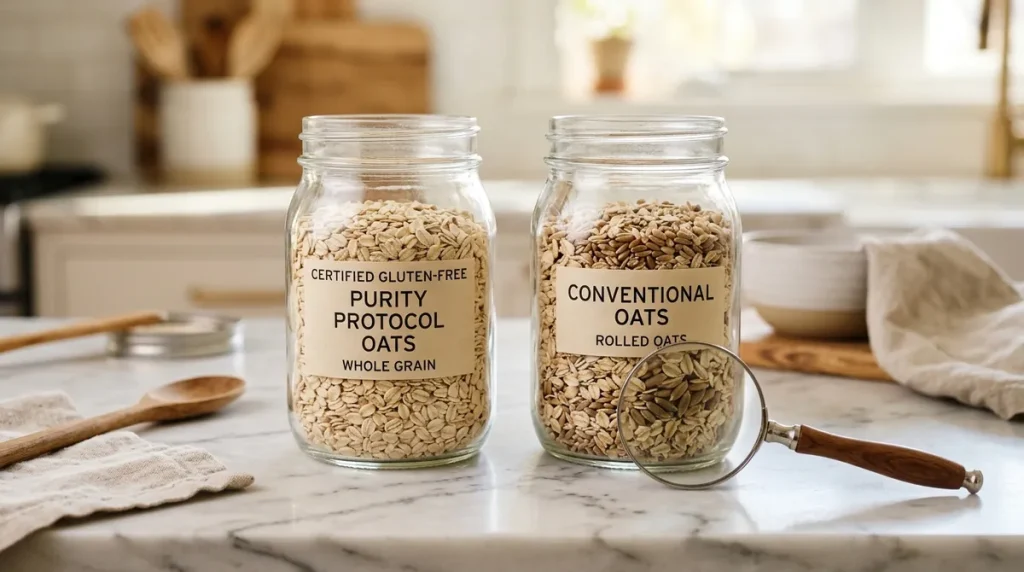
Not all “gluten-free” oats are created equal. There are two main approaches brands use to ensure their oats are safe, and the difference matters.
Purity Protocol vs. Mechanical Sorting
Purity protocol oats are grown on dedicated fields, harvested with dedicated equipment, and processed in gluten-free facilities from seed to shelf. This is the gold standard.
Mechanically sorted oats (sometimes called “optically sorted”) start as conventional oats and use machines to remove visible wheat, barley, and rye kernels. While this reduces contamination significantly, some celiac researchers and advocacy groups argue it may not catch every trace of gluten, especially at the flour level.
The Cheerios debate is a perfect example of this controversy — General Mills uses mechanical sorting, which is why their products meet the FDA’s 20 ppm threshold but are not certified by the Gluten-Free Certification Organization (GFCO).
Purity protocol, GFCO certified, widely available at most grocery stores and online. This is the brand I use for my boys’ oatmeal and all our GF baking.
One of the original purity protocol brands. Farmer-owned and GFCO certified. Whole oats, quick oats, and oat flour available. ~$7-9 per bag.
Purity protocol, GFCO certified, processed in a dedicated gluten-free facility. Great for granola and baking. ~$6-8 per bag.
Purity protocol from dedicated GF farms. Available online and at specialty stores. A trusted name in the celiac community. ~$8-10 per bag.
Purity protocol, tested below 20 ppm. Popular in Canada and available online in the US. ~$8-12 per bag depending on retailer.
| Brand | Protocol | Certified GF | Availability |
|---|---|---|---|
| Bob’s Red Mill GF Oats | Purity Protocol | ✓ GFCO | Nationwide |
| GF Harvest | Purity Protocol | ✓ GFCO | Online / Specialty |
| Bakery On Main | Purity Protocol | ✓ GFCO | Nationwide |
| Montana Gluten Free | Purity Protocol | ✓ GFCO | Online / Specialty |
| Quaker “GF” Oats | Mechanical Sorting | ✗ Not GFCO | Nationwide |
Brands to Approach with Caution
Quaker Gluten-Free Oats use mechanical sorting rather than purity protocol. While they meet the FDA’s 20 ppm standard, many in the celiac community have reported reactions. Independent testing by organizations like the Gluten-Free Certification Organization has found variability in their contamination levels.
Any store-brand “gluten-free” oats without a third-party certification seal deserve extra scrutiny. Read the package carefully — look for the GFCO logo, the Celiac Support Association’s recognition seal, or explicit mention of purity protocol sourcing.
Common Mistakes When Adding Oats Back to a Celiac Diet
- Introducing oats too early. If you’re still symptomatic or your antibodies haven’t started dropping, adding oats makes it impossible to tell what’s causing your symptoms. Wait until you have a baseline of healing.
- Buying conventional oats and assuming they’re fine. Even if the front label says “whole grain” or “heart healthy,” conventional oats are almost certainly contaminated. You need the words “gluten-free” and ideally a third-party certification.
- Eating too much too fast. Starting with a big bowl of overnight oats on day one is a recipe for confusion. If you react, you won’t know if it’s the quantity, contamination, or avenin sensitivity. Start small.
- Ignoring subtle symptoms. Not every reaction is dramatic GI distress. Increased fatigue, brain fog, joint pain, or skin issues in the days after eating oats can also indicate a problem. Track everything.
- Assuming “gluten-free” baked goods with oats are safe. Many gluten-free cookies, granola bars, and cereals contain oats. If you haven’t yet confirmed you tolerate oats, these products could be an issue.
- Skipping follow-up bloodwork. You can feel perfectly fine while still experiencing subclinical intestinal damage. Follow-up tTG-IgA testing is the only way to be sure oats aren’t causing hidden harm.
Nutritional Benefits of Oats for the Gluten-Free Diet
If you can tolerate oats, they’re honestly one of the best things you can add to a GF diet. Many people with celiac disease struggle to get enough fiber, B vitamins, and minerals — and oats deliver all three.
One half-cup of dry rolled oats provides approximately 4 grams of fiber (including beta-glucan, a soluble fiber linked to heart health), 5 grams of protein, and meaningful amounts of iron, magnesium, and zinc. For a community that often battles nutritional deficiencies, that’s significant.
My boys love overnight oats with banana and peanut butter, and I use certified GF oat flour in everything from oatmeal raisin cookies to muffin recipes. Oats also add a heartiness to gluten-free baking that’s hard to replicate with other flours.
Conventional oats are almost always cross-contaminated with wheat, barley, or rye from shared farming and processing equipment. However, purity protocol oats are grown, harvested, and processed using dedicated gluten-free equipment and facilities, making them safe for most people with celiac disease. Always look for GFCO certification or explicit purity protocol labeling.
There’s currently no commercially available test for avenin sensitivity. The only reliable method is a carefully monitored introduction of certified gluten-free oats, starting with small amounts and tracking symptoms over several weeks. Follow-up bloodwork (tTG-IgA) at 3 and 6 months can help detect subclinical intestinal damage even if you feel fine.
Research suggests most adults with celiac disease can safely consume up to 50-70 grams of certified gluten-free oats per day (roughly half a cup of dry oats). For children, the recommended limit is typically lower — around 20-25 grams per day. Always start with smaller amounts and increase gradually while monitoring for symptoms.
Purity protocol oats are grown on dedicated gluten-free fields and processed in GF-only facilities from seed to package. Mechanically sorted oats start as conventional oats and use optical sorting machines to remove visible gluten-containing grains. Purity protocol is considered the safer option for celiac disease, as mechanical sorting may miss trace-level contamination.
Many pediatric gastroenterologists do allow certified gluten-free oats for children with celiac disease, but recommendations vary. Some suggest waiting until the child’s antibodies have normalized and symptoms have resolved before introducing oats. Always work with your child’s doctor and start with very small amounts. Consult the National Institute of Diabetes and Digestive and Kidney Diseases (NIDDK) for additional guidance.
Making the Right Call on Oats With Celiac Disease
So, can you eat gluten-free oats if you have celiac disease? For most people, yes — but with important caveats. The oats must be certified gluten-free (purity protocol is best), you should introduce them slowly after your gut has begun healing, and follow-up monitoring with your gastroenterologist is essential. This isn’t a decision to make based on a blog post alone, including this one.
If you’re one of the roughly 8-12% of celiac patients who reacts to avenin, oats simply won’t work for you — and that’s okay. There are plenty of other ways to get fiber, nutrients, and satisfying breakfasts on a wheat-free diet. When I first went gluten-free, the uncertainty around oats felt like one more thing making an already overwhelming transition harder. But once we found brands we trusted and learned to listen to our bodies, oats became a welcome (and delicious) part of our routine.
The most important thing? Work with your healthcare team, choose your oat brands carefully, and give yourself permission to go slow. You’re doing the right thing by researching this — and your gut will thank you for being thorough.
