
May is Celiac Awareness Month, and if you’re reading this, you probably know firsthand that going gluten-free is about so much more than swapping out bread. It touches every meal, every grocery trip, every birthday party, every vacation — and some days, it just feels like a lot.
I get it. When our family first went gluten-free, I remember standing in the cereal aisle for twenty minutes, reading labels and fighting back tears. It felt like every product I picked up was hiding gluten somewhere. The learning curve was steep, the mistakes were frequent, and honestly? I felt really alone.
But here’s what I wish someone had told me back then: it does get easier, and there are specific, practical things you can do right now to make daily gluten-free living less stressful. As a registered nurse and a mom who’s been managing a gluten-free household for years, I’ve learned that the right systems and shortcuts make all the difference.
This Celiac Awareness Month 2026, I’m sharing 25 of my best gluten-free tips for beginners and seasoned GF families alike — organized by the areas of life where you need them most. Bookmark this page. Share it with someone who was just diagnosed. Let’s make this the month you stop surviving gluten-free and start feeling confident about it.
Key Takeaways
- Going gluten-free gets dramatically easier once you build simple systems for shopping, cooking, and eating out — these 25 tips cover every category.
- Label reading and cross-contamination awareness are the two most important skills to develop in your first year of gluten-free living.
- You don’t have to overhaul everything at once — start with 3-5 tips from this list and add more as they become habits.
- Celiac Awareness Month is the perfect time to educate the people around you and advocate for safer options at schools, restaurants, and workplaces.
- Free tools, apps, and printable resources exist to make every aspect of gluten-free life more manageable — and we link to the best ones below.
Shopping & Label Reading Tips
The grocery store is where most of the daily stress of going gluten-free happens. These first several tips will help you shop faster, spend smarter, and stop second-guessing every label.
1. Learn the Eight Words That Signal Hidden Gluten
Beyond the obvious wheat, barley, and rye, watch for these on ingredient lists: malt, malt extract, malt flavoring, brewer’s yeast, modified food starch (when the source isn’t specified), hydrolyzed wheat protein, seitan, and triticale. Print this list and keep it in your wallet until it’s second nature.
2. Understand What “Certified Gluten-Free” Actually Means
The Gluten-Free Certification Organization (GFCO) tests products to 10 parts per million (ppm) — stricter than the FDA’s 20 ppm threshold. Look for the GFCO stamp or the Celiac Support Association’s seal. A product can say “gluten-free” on the label without any third-party testing, so certifications give you an extra layer of confidence.
3. Shop the Perimeter First
Produce, meat, dairy, and eggs are naturally gluten-free. When you build meals around these whole foods, you spend less time reading labels and more time actually cooking. My boys eat more fruits and vegetables now than they ever did before we went GF — not because I’m a superhero, but because the perimeter of the store is simply easier to navigate.
4. Pick Two “Home Base” Stores and Learn Their GF Sections
Trying to know every gluten-free product at every store is exhausting. Instead, choose two stores and get to know their GF inventory inside and out. For many families, a mainstream grocer like Target plus a budget store like Aldi or Costco covers most needs.
5. Use a Gluten-Free App at the Store
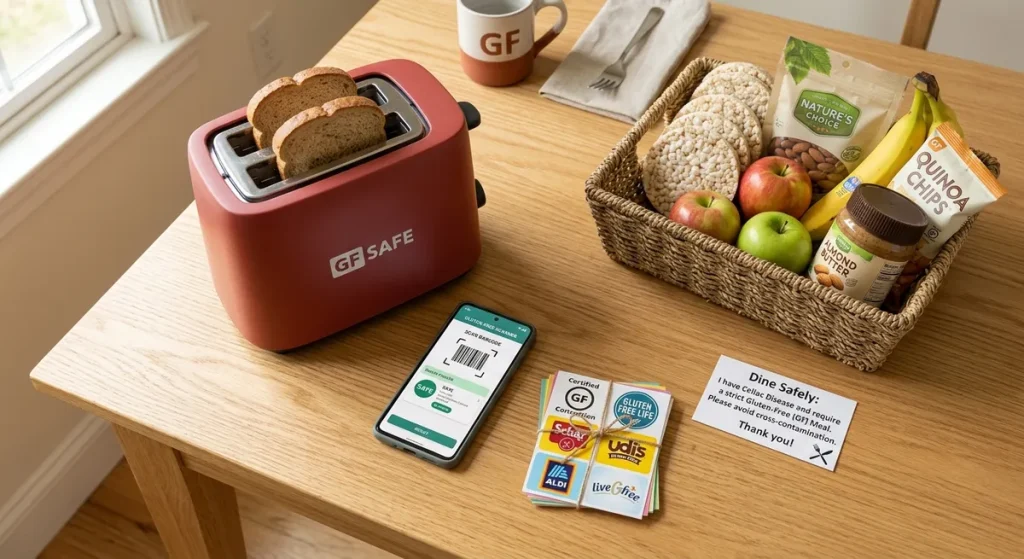
Apps like the Nima app, the Find Me Gluten Free app, and scanner-based grocery apps can save you ten minutes per shopping trip — and a lot of anxiety. Pull out your phone, scan the barcode, and get an instant answer. My oldest, Austin, actually loves being the “scanner helper” at the store.
6. Don’t Forget to Check Medications and Supplements
This is one of the most overlooked aspects of going gluten-free. Some medications use wheat starch as a filler, and many supplements contain gluten-based binders. Always check with your pharmacist, and use databases like Beyond Celiac’s medication resource or call the manufacturer directly.
Kitchen Setup & Cross-Contamination Tips
Your kitchen is the one environment you can fully control. Making it truly celiac-safe doesn’t require a full renovation — just a few intentional changes.
7. Get Your Own Toaster (Seriously, This One’s Non-Negotiable)
Shared toasters are one of the biggest sources of cross-contamination in mixed households. A dedicated gluten-free toaster costs about $20 and eliminates a major risk. Label it clearly. When my boys’ friends come over, we have a strict “red toaster is GF only” rule and it works perfectly.
8. Replace Porous Kitchen Items That Can’t Be Fully Cleaned
Wooden cutting boards, wooden spoons, silicone baking mats with scratches, and non-stick pans with worn coatings can all harbor gluten residue. You don’t need to replace everything at once — start with cutting boards and your most-used baking tools.
9. Create a Dedicated GF Zone in Your Kitchen
If you live in a mixed household (some family members eat gluten, some don’t), designate one shelf, one cabinet, or one section of counter space as the gluten-free zone. Use colored tape, labels, or separate containers. This visual boundary helps everyone in the family — especially kids — understand the rules.
10. Use the “Clean, Separate, Dedicate” System
Clean: Wipe down counters and wash hands before preparing GF food. Separate: Use different utensils for GF and gluten-containing items (separate colanders, separate butter, separate peanut butter jars). Dedicate: For items that can’t be reliably cleaned, dedicate them exclusively to gluten-free use. This three-word system is easy enough for the whole family to follow.
🔧 Kitchen Cross-Contamination Quick Checklist
- Separate GF toaster purchased and labeled
- Wooden utensils and cutting boards replaced or dedicated
- Separate condiment jars (butter, PB, jam) marked clearly
- Dedicated GF shelf or cabinet space established
- Non-stick pans with worn coatings replaced
- Separate colander for GF pasta
Meal Prep & Cooking Tips
Cooking gluten-free doesn’t have to mean spending your entire Sunday in the kitchen. These tips are about working smarter, not harder.
11. Master Five “Base Meals” Before Branching Out
When you’re newly GF, recipe overwhelm is real. Instead of trying a new recipe every night, pick five simple dinners your family already likes that are naturally gluten-free or easy to adapt: think tacos with corn tortillas, stir-fry with tamari, baked chicken with roasted vegetables, rice bowls, and chili. Once those five feel effortless, add one new recipe per week.
12. Batch Cook Proteins and Grains on Sunday
Spending 90 minutes on a Sunday cooking a big batch of chicken, ground beef or turkey, rice, and quinoa sets you up for fast weeknight meals all week long. Store them in portioned containers and you’ve got the building blocks for bowls, wraps, salads, and casseroles.
13. Keep a “GF Emergency Meal” Kit in Your Pantry
Bad days happen. Kids have meltdowns. Exhaustion wins. For those nights, keep a stash of meals you can throw together in under 15 minutes: gluten-free pasta with jarred marinara, rice and canned beans with salsa, or frozen GF pizza. No guilt — just dinner on the table.
14. Freeze in Single Servings for Lunches
Whenever you make a big batch of soup, casserole, or muffins, freeze half in individual portions. This gives you grab-and-go lunches that are celiac-safe — no drive-through roulette required. I label everything with the date and contents using painter’s tape and a Sharpie.
15. Learn Two Gluten-Free Flour Blends and Stick With Them
GF baking can feel impossible when every recipe calls for a different blend. Pick one all-purpose blend (like Bob’s Red Mill 1-to-1 Baking Flour or King Arthur Measure for Measure) and one lighter blend for cakes and muffins. As you gain confidence, you can experiment — but having two reliable go-tos removes so much friction.
Eating Out & Social Situations Tips
Restaurants and social events are where many people feel the most stress — and the most isolation. These tips won’t eliminate the challenges, but they’ll help you navigate them with more confidence.
16. Call the Restaurant Before You Go
Don’t rely on the online menu alone. Call during off-peak hours (2-4 PM is ideal) and ask to speak with a manager or chef. Ask specifically: “Do you have a protocol for preparing gluten-free meals to prevent cross-contamination?” Their answer will tell you everything. Vague responses like “we can make anything gluten-free” are a red flag.
17. Use a Dining Card
A gluten-free dining card is a small printed card (or a card on your phone) that explains your dietary needs clearly and specifically. Hand it to your server. It takes the pressure off you to explain everything verbally, and it gives the kitchen written instructions they can reference. This is especially helpful if you deal with any social anxiety around your diagnosis.
18. Always Eat Something Before Events Where You’re Not Sure About the Food
Birthday parties, office potlucks, holiday dinners at extended family’s house — you never know what will be safe. Eating a solid snack or small meal beforehand means you won’t be hungry and anxious if nothing at the event is safe for you. I always feed the boys before parties and send a GF cupcake in their lunchbox just in case.
19. Bring a “Safe Dish” to Potlucks and Gatherings
Offer to bring something delicious that happens to be gluten-free. You’ll guarantee yourself at least one safe option, and you’ll probably introduce others to how good GF food can be. Our gluten-free spinach dip has converted more skeptics than I can count.
20. Have a Go-To Response Ready
You will get questions. Some will be well-meaning, some will be annoying, and some will be downright dismissive. Having a rehearsed response helps: “I have celiac disease — my immune system attacks my intestines when I eat gluten, so I have to be really careful. Thanks for understanding!” Short, factual, and done.
School, Kids & Family Life Tips
If you’re raising gluten-free kids, you know the challenges multiply. School lunches, playdates, craft supplies (yes, really) — it all requires planning. These tips come straight from my experience navigating this with Austin and Alex.
21. Meet With Your Child’s Teacher Before School Starts
Don’t wait for the first classroom birthday party to be a disaster. Schedule a meeting with the teacher (and school nurse, if possible) before the school year begins. Explain celiac disease, cross-contamination, and what your child can and cannot eat. Provide a written plan and a stash of safe treats the teacher can keep on hand for unexpected celebrations.
22. Teach Kids to Self-Advocate Early
Even at six years old, Alex can say, “I can’t eat that — I have celiac disease. Can I see the package?” Teaching your child to speak up for themselves is one of the most important things you can do. Practice at home. Role-play scenarios. Celebrate them when they advocate for themselves in the real world.
23. Pack Lunches That Don’t Scream “Different”
Kids don’t want to feel singled out. Pack lunches that look similar to what other kids are eating: GF sandwich on bread that looks like regular bread, crackers and cheese, fruit, and a fun snack. Brands like Schar and Canyon Bakehouse make sandwich bread that holds up well in lunchboxes.
Travel & On-the-Go Tips
Traveling gluten-free requires extra planning, but it doesn’t have to steal the joy from your trips. Here’s how to make it work.
24. Pack a GF Travel Kit
Whether it’s a road trip or a flight, always bring more GF snacks than you think you’ll need. My travel kit includes: individual nut butter packets, GF granola bars (I like KIND bars that are certified GF), dried fruit, rice cakes, beef jerky, and a few pieces of fresh fruit. I also pack GF bread and PB&J supplies for longer trips, because finding safe food at highway rest stops or airports is unreliable at best.
🛒 Katie’s GF Travel Snack Kit
- KIND Bars (certified gluten-free varieties)
- Justin’s individual nut butter squeeze packs
- Lundberg rice cakes (individual packs)
- Epic beef jerky bars
- Dried mango or apricots
- Schar or Canyon Bakehouse bread + GF peanut butter + jam
- Disposable utensils and wipes
25. Book Accommodations With a Kitchen Whenever Possible
This single tip has saved us more stress (and money) on vacation than anything else. A small kitchenette — even just a mini-fridge, microwave, and a couple of burners — means you can make safe breakfasts and lunches and save eating out for dinner. Platforms like Airbnb and Vrbo make this easy to filter for, and many extended-stay hotels offer kitchenettes too.
Common Mistakes to Avoid When Going Gluten-Free
Even with the best intentions, there are some pitfalls that trip up almost everyone — especially in the first year. Here’s what to watch out for.
Mistake #1: Assuming “Wheat-Free” Means Gluten-Free
A product can be wheat-free and still contain barley or rye, both of which contain gluten. Always check for all three grains and their derivatives. The FDA’s gluten-free labeling rule requires products labeled “gluten-free” to contain less than 20 ppm of gluten, but “wheat-free” has no such standard.
Mistake #2: Not Reading Labels on Products You’ve Bought Before
Manufacturers change ingredients and manufacturing processes without warning. A product that was safe last month might not be safe today. Get in the habit of scanning the label every single time — even on products you buy regularly.
Mistake #3: Relying Only on Restaurant “Gluten-Free Menus”
A gluten-free menu doesn’t guarantee a gluten-free kitchen. Many restaurants prepare GF items on the same surfaces, in the same fryers, or with shared utensils. Always ask about preparation methods, not just menu labels.
Mistake #4: Ignoring Cross-Contamination in Shared Condiments
When someone double-dips a regular breadstick into the shared butter, that butter is no longer safe. Same goes for jam jars, peanut butter, cream cheese, and any other spreadable condiment. In a mixed household, use squeeze bottles or dedicated GF jars.
Mistake #5: Trying to Replace Everything at Once
Going gluten-free doesn’t mean you need to buy GF versions of every single product you used to eat. Start with the staples — bread, pasta, crackers, cereal — and add specialty items gradually. Trying to do a complete pantry overhaul in one grocery trip is expensive and overwhelming.
Mistake #6: Not Getting Follow-Up Testing
If you’ve been diagnosed with celiac disease, follow-up blood work (typically tTG-IgA) is important to confirm that your antibody levels are decreasing on the gluten-free diet. Many people with celiac find that this reassurance — seeing real numbers improving — helps them stay motivated. Talk to your gastroenterologist about a testing schedule.
How to Use Celiac Awareness Month to Make a Difference
Celiac Awareness Month isn’t just about personal survival tips. It’s an opportunity to educate the people around you and advocate for better options — at school, at work, at restaurants, and in your community.
Celiac Awareness Month in 2026 comes at an exciting time. Research into potential therapies, better diagnostic tools, and even a possible vaccine is progressing. Your voice — as a patient, a parent, or a supporter — matters more than ever.
Frequently Asked Questions
Celiac Awareness Month is observed every May in the United States. It’s dedicated to raising public awareness about celiac disease, an autoimmune condition affecting roughly 1 in 100 people worldwide. Organizations like the Celiac Disease Foundation and Beyond Celiac lead awareness campaigns, fundraising, and educational events throughout the month.
The most impactful gluten-free tips for beginners are: learn to read food labels thoroughly, set up a cross-contamination-free kitchen zone, master five naturally gluten-free meals, download a GF scanning app, and find two reliable grocery stores. Focus on building these foundations before worrying about specialty products or complicated recipes.
Many people with celiac disease report some symptom improvement within the first 1-2 weeks of strict gluten elimination. However, intestinal healing can take 6 months to 2 years or longer, depending on the extent of damage. Research suggests that consistent adherence to the diet is the most important factor in recovery. Consult your gastroenterologist for personalized guidance. Read our full timeline in How Long Does It Take to Feel Better After Quitting Gluten?
Yes. For people with celiac disease, even tiny amounts of gluten — as little as 10-50 milligrams — can trigger an immune response and cause intestinal damage, according to research cited by the Celiac Disease Foundation. This is why separate toasters, condiment jars, and cooking surfaces are so important. Cross-contamination can cause harm even when you don’t feel symptoms.
If you accidentally eat gluten, stay hydrated, rest, and eat gentle, easy-to-digest foods for the next 24-48 hours. Symptoms can last anywhere from a few hours to several days. If you experience severe or prolonged symptoms, contact your doctor. Our detailed guide on accidental gluten exposure recovery covers symptoms, timelines, and when to call your doctor.
Share educational content on social media, talk openly about your experience, leave positive reviews for GF-friendly restaurants, educate your child’s school, and consider donating to celiac research organizations. Even simple conversations with friends and family help break down misconceptions about celiac disease and the gluten-free diet.
You’re Not Alone This Celiac Awareness Month
Going gluten-free is hard — there’s no sugarcoating it. But it doesn’t have to stay as hard as it is in those first overwhelming weeks and months. Every system you put in place, every label-reading skill you build, every conversation you have with a teacher or a server makes the next day a little easier than the last.
This Celiac Awareness Month 2026, I want you to take just three tips from this list and put them into action this week. Maybe it’s buying a separate toaster, downloading a GF app, or batch cooking proteins on Sunday. Small, consistent steps create big change over time. You don’t have to do this perfectly. You just have to keep going.
And remember — you’re not alone in this. Millions of families are walking this same path, and communities like ours exist to help you feel supported every step of the way. If this article helped you, share it with someone who needs it. That’s what awareness month is all about.
